Thứ Tư, 9 tháng 12, 2015

Door ceremony and counting the Dowry

Door ceremony
In order for the wedding to continue, the groom must bring the bride from her room to join him for the engagement ceremony. However, before this can happen, the groom must successfully pass through a number of obstacles that are put in the groom’s way by the bride’s family. These symbolic “doors” can only be entered once the groom has proved his worth to the keepers of the “locks”.
Normally, there are just 3 of these symbolic “doors”, but there may be more. Typically there are gold and silver gates represented by gold or silver belts or necklaces which is held by two female members of the bride’s family or friends. These days the doors are also represented by flower strings. At my friend’s wedding, there were nine doors and they were represented by lovely orchid.

The groom can sometimes be questioned and is occasionally teased during this activity as the family light-heartedly determined whether he can pass through each “door”. His passage to the next “door will only be granted once a “toll” has been negotiated with the keeper of the “lock”.
We didn’t let the groom pass easily.
The toll for each subsequent “door” will increase as the groom successfully advances. I saw the doorkeepers of the few first gates got 100 Baht to open the door. I was the guard of the last door, so I accepted 1,000 Baht to let the groom passed.
Depending on circumstances it can either be the groom or his ‘Thao Gae” that hands over the money envelopes to the gate guardians.
This part of the wedding ceremony is the most ‘sanuk’ with plenty of laughter and frivolity most of which comes at the expense of the groom as he is teased and gently ribbed by the bride’s family.


  Counting the Dowry
Once the gates have been successfully negotiated, the groom can take the bride from her room to continue the next part of Thai wedding ceremony which is the dowry ceremony.
Thai marriage at large and definitely the ceremony of traditional Thai wedding interlinked with an ancient tradition called sinsod (สินสอด). A custom of paying a dowry (dowery) to compensate a family of bride “for mother’s milk”. A concept of sinsod was initially brought in to ensure that one’s daughter does not marry below her potential standing in life. To stipulate that her social, financial and professional status and reputation is preserved and secured.

Traditionally, a downry (สินสอด /sĭn-sàwd/) will be formally presented by the groom’s parents to the bride’s parents on the Kan Maak tray. This dowry will consist of money, gold, jewellery or title deed. The dowry is then counted out onto a red cloth by the bride’s parents. The amount of the dowry is usually predetermined which is intended to represent prospective wealth for the couple.
There is no set amount, the sum of sinsod is typically determined on the one hand by suitor’s perceived wealth, and on the other hand by the “value” of the future wife. Her beauty, personality, background, education and other qualifications, if she is a virgin, or has got a child, and so forth.
Nowadays, many parents-in-law hand the dowry back to the married couple as a wedding gift, some families do not require a dowry, and some need to keep the money. Traditionally, sinsod is reciprocated by the parents-in-law. More often than not, a part of the money is used to pay for the wedding ceremonies, parties and other related expenses. Dowries or sinsod payments range from THB 50,000 to 250,000 and up.
The bride’s parents gave some money for the couple as a gift to start their family.


Khan Maak Procession

* Engagement Tray (Khan Mak)

According to Thai customs, a couple traditionally becomes engaged during a ceremony known as “Kan Maak“ (ขันหมาก /kăn-màak/).  ขัน/kăn/ means ‘bowl’ and หมาก /màak/means ‘betel nut';  ‘Kan Mak’ means “bowl of betel nuts” .

Things to put in the Khan Mak tray may vary by culture in different regions. These items represent important aspects of the marriage, such as health, prosperity, fertility and longevity. Generally items in the Kan Maak tray are ;
11.  The young betel nuts (หมาก màak) 4 or 8 pieces
22.  Betel leaves (ใบพลู bai pluu)
33.  Silver bag (ถุงเงิน tŭng ngern) which contains money, usually coins
34.  Golden bag (ถุงทอง tŭng torng) which contains mung beans, popped rice, sesame seeds
45.  Meaningful flowers which commonly be;
- Calotropis gigantea (Crown flower) which in Thai is called ‘ดอกรัก dòrk rák’ ; ‘รัก rák’ means ‘love’
- Globe amaranth which in Thai is called ‘ดอกบานไม่รู้โรย dòrk baan mâi rúu roai’ ; the name means ‘always bloom’, so the couple’s love will always bloom.
– Marigold which in Thai is called ‘ ดอกดาวเรือง dòrk daao rueang’ , the name เรือง rueang sounds like the word ‘รุ่งเรือง rung rueang’ meaning ‘prosperous’.
The rings tray made of banana leaves, Calotropis gigantea flowers and Globe amaranth.
Culture Note: Why betel nuts and betel leaves?
In the old time, like Vietnam, Thai people liked to chew betel nuts and betel leaves. They were common items every household had and they were used to welcome the guests visiting the house. Therefore betel nuts and betel leaves are used as a gift to represent harmony in Thai wedding.

* Khan Maak Procession


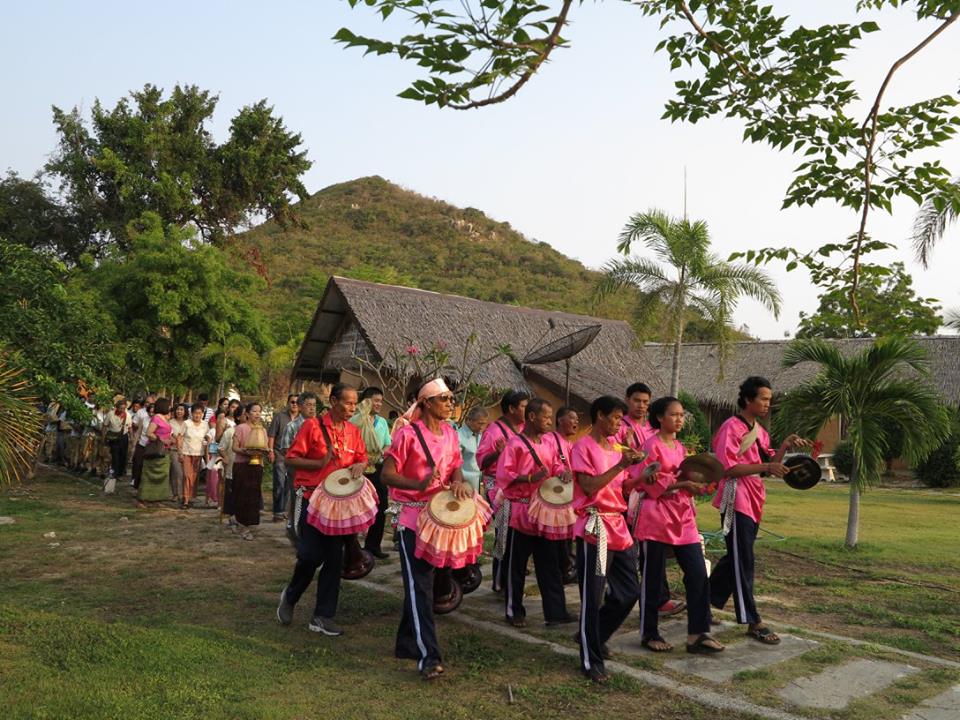
When the time comes for this auspicious occasion, the proceeding begins with the arrival of the groom and his entourage at the front of the bride’s house.The procession is lead by the groom’s representative or “เถ้าแก่ Thao Gae”, and his parents, relative and friends also accompany him carrying flowers, incenses, candles and gifts.  The parade will be lead by drummers and traditional folk dancers, whose lively celebrations announce their arrival to all around.
The groom in Khan Maak procession. He looks very happy
Banana leaves and sugar canes are paraded like banners by some of the attendants, while others bear the traditional gifts of the Kan Maak, which includes rice, sesame seeds, Thai food for the feast and many Thai desserts, as well as monetary gifts and other precious items, such as gold and jewellery, which will make up the dowry to the bride’s parents later on in the ceremony.
Many of these gifts represent important aspects of the marriage, such as health, prosperity, fertility and longevity.
The groom’s Kan Maak tray
The Thai desserts to be eaten as part of the feast consists of nine different items. The number 9 is important in Thai society and it’s use on occasions such as this is regarded as very lucky.

The timing procession (ฤกษ์)  is also important, as it will have been calculated to occur at the most auspicious moment for the couple. It is also common for the lucky number 9 to figure in these calculations as well. My friend’s Khan Mak procession started at 09:09 a.m.
When the procession finally arrives at the Bride’s home they will be met by the bride’s family, who will invite the groom into the home to conduct the next part of the ceremony.


RULES OF THAI WEDDING ETIQUETTE

Here is several rules which you need to note when being invited to a wedding celebration. We collect from: http://a.northernthailand.com/thai-weddings/454-thai-wedding-etiquette20.html. I contend that they will be very useful to keep it in mind
1) It is not acceptable to wear Black to a wedding, period. So that little go anywhere black dress has finally found a place it is not allowed to go! It is because Black is the traditional colour for funerals. So you will be considered as offensive, to imply this is his or her funeral for marrying your best mate or co-worker.Same men for shirts, suits and slacks. 


2) Ladies I know back home the reverend may not mind the low cut tops in the congregation below him, however in the temple it is just considered classless. So guys if you wish to have any chance of tenure, be sure you or your girl dress appropriately at all temple ceremonies.

3) Sorry same but the short skirts! At the temple you will find that you are expected to be on the floor and sorry to say you may not have the finesse to sit on the floor and not have the panties show. Even the girls that have to work in the sex trade understand this and cover up to show due respect when they go to temple.
4) Please remember while on the floor (in Pain for many westerner) please do not point your feettowards the monk or even a Buddha statute.
5) It is not really allowed to stand above the monk while he is seated , even when taking photographs. For the ladies sorry it is a true no no too.
6) Remember it is not rude to place money in an envelope instead of a normal western wedding gift. It is of course your choice. But remember most young Thai couples have real needs that come before a toaster. So kind of think of it as a block party concept and you can ’t go wrong.


WEDDING INVITATIONS

Like in Vietnam, In Thailand, invitations are delivered to friends and relatives before about one week. 


In these invitations, each of the most important ceremony will be mentioned. As we know, Thai people are not reknowned for their punctuality, but in the wedding they will pay more attention to the time because their punctuality absolutely brings good fortune to the couple. 


The interesting thing  in the wedding is that the amount of guests is unpredictable. Everyone is whether the rich or the poor, the intimate or the strange can be invited and partake in. It is firmly believed that the more people they come, the happier the future life is. Therefore the list of guests are not essential here. 


Source:


CHOOSING THE WEDDING DATE

Marriage is one of the most important events in a person’s life, therefore, it is always paid much attention. 


To ensure a happy and prosperous marriage, wedding day should be celebrated at an auspicious time. While Viet Namese people have a fortune-teller choose the date, the Thai people often find the help of monks or astrologers. As for monks, they will depend on the birthdays and the time of birth of the couple.  It will be the day or the time which is not incompatible with their ages


 On the other hand, as for astrologers, they will observe lunar calendar and the harmony of the stars. It is believed that the day on which the stars are compatible is the best choice. 


Another thing is that the time also relates the number 9 such as 09.09 because 9 is the lucky number in Thailand. 


Source:

Thai Buddhist Blessing

  In the past, even numbers of monks such as four or eight were invited. However, nowadays Thai people believe that number nine is a lucky number. Accordingly, nine monks are usually invited, and with one Buddha image at the ceremony this comes to ten, thus making even number.

The couple also invited nine monks to their ceremony. First, the bride and groom will light 2 candles on the altar Buddha.

Groom’s mother will put Mongkol on the head of the bride, and similar bride’s mother will put Mongkol on the head of the groom with meaning mount their lifes together.
Mongkol was braid by thread, are the monks mantras before the wedding happening.

The monks will bring auspicious and mercy for the young couple by recite the Pali. A thread is connected to the monk or a water bottle with auspicious idea will be transmitted to the thread or water bottle to the young couple. Blessing ritual of Thai culture and water will drip candle wax will be done in front of the statue. Mark on forehead groom is made up of monks thumb still on the bride's forehead is created by pieces of candles by the customs of Thailand is Thai monks are not allowed to touch women.


After the chant finished, the wedding couple and their relatives offered food to the monks. Nobody else is permitted to eat until the monks have finished their meal. Then the monks left the ceremony.
The ceremony took place on the background music Khim - a traditional Thai musical instruments, sound as melodious zither of Vietnam.


THAI WEDDING ATTIRE

 Wedding attire will vary significantly depending on the region of Thailand. Both type  of costume and color will be different or hold a changing significance depending on the ares too. Common colors are white or creamy and the only exception is using the color black, as it is considered to be bad luck. Traditionally, a bride's dress is made of silk or handwoven cotton, which are natural fabrics that help keep the wearer cool in warmer weather. 


However, since it is the tradition of Thai wedding dresses to be influenced by modern trends, most designs or fabrics used are generally accepted. Today, exquiste wedding attires can be made of silk. They look stunningly magnificent in the bellow picture.


Generally, the groom wears a long-sleeved, loose fitting shirt of cotton or a more luxury fabric. His shirt may have embellishments or embroidery and he will wear an ornate sash across his body from his left shoulder. This is usually decorated with relevant traditional symbols and he may have a corsage of flowers pinned to it. The groom's trousers reflect region or personal taste! In some areas they will be just like long, loose linen trousers, whilst in other regions they seem more Arabic in style and fabric and may be approximately 3/4 or calf-length.


Thai brides will wear a costume which traditionally “matches” the groom’s in some way, for example her dress may be  the same color as his sash. Traditional dresses include two-piece costumes of a top and wrap around skirt, which can be full-length or ankle length. The bride will wear a headdress and either carry or wear flowers.


Looking at below pictures, Thai wedding attires are not only elegant but versatile as well. If you are scheduled for a Thai wedding, do not forget considering a Thai wedding costume


Source: